
Author Interview
Can you tell us a little about your publishing journey, please?
The publishing journey, on reflection, began one damp Friday evening in Clacton-on-Sea Library. I was thirteen years old. I’d haunted the place for years. I was looking at all those books on all those shelves and I suddenly asked myself what was stopping me adding a book of my own. I lived for stories – often other peoples’, sometimes my own. We had no telly. The evenings were dark and my parents barricaded themselves behind a wall of classical music. And so that same weekend, thanks to my mum, I acquired a pile of foolscap, a box of carbon paper, and laid hands on a borrowed typewriter.
The publishing journey started in earnest the following day – a Monday. I sat mutely at my parents’ card table fingering the green baize top and staring at the blank sheet in the borrowed typewriter. What on earth was I going to write about? How was I going to handle plot and character and all the other writerly stuff? And just how much did I really know about real life that could possibly be of any interest to anyone else? The answers to all these questions slowly resolved themselves over the months and years to come, and by the time I made it to Cambridge, I had seven (mercifully) unpublished novels, plus a pile of rejection slips to prove it.
Unabashed, I wrote two more novels over the next three years – technically better but still unpublished – and after graduation I was about to leave for Paris to starve beautifully in pursuit of my chosen vocation but somehow managed to hook a job in commercial television, which opened a host of other doors. Over the next decade and a half I learned a completely different trade, making documentaries all over the world.
Shamefully, by now, I’d quietly postponed my career as a nascent novelist but then came an assignment to join an American expedition to find and film the wreck of the Titanic. It took a while to lay hands on the beast, and I used those long days to pen and submit a synopsis for a six-part ITV drama called ‘Rules of Engagement’. The day we finally laid hands on the liner, plus the extraordinary debris field between the two portions of the wreck, I got word on the radio telephone from London that the ITV drama honchos had green-lighted my synopsis and commissioned six scripts. In retrospect, that was the moment when my life changed forever – not because we’d found the Titanic but because I knew I could finally find myself a literary agent and acquire a contract for the novelization of that same drama idea, to coincide with transmission of the filmed series.
And so it proved. Rules of Engagement was published by Pan/Macmillan in 1990. A second two-book contract was in the offing and in 1992 I left the world of TV documentaries and became a full time writer. In all I did seven ‘international thrillers’ for Pan/Mac, and then moved to Orion where I wrote two more stand-alones, followed by a non-fiction special entitled ‘Airshow’. Orion had a decent track record in crime fiction, and at their invitation I wrote sixteen cri-fis. The D/I Faraday novels were all based in Portsmouth, where we lived, and in translation they travelled far and wide. The French produced a series of magnificent feature-film adaptations and over the years that followed we haunted endless French cri-fi festivals where I did my best to nail Faraday’s gruff attractions to a whole generation of French female readers.
Alongside police procedurals, I wrote a sextet of novels voiced by an Anglo-Breton actress, Enora Andressen, but the magnetic pull of WW2 proved too strong to resist and thanks to my lovely agent Oli Munson, and Nic Cheetham at Head of Zeus, I was finally able to tunnel out of the cri-fi Gulag and start afresh. Nic and I agreed the ground rules for the ‘Spoils of War’ collection over our first lunch: no central character, no leaden chronological plod through those seven years of organised violence, but a repertory cast of recurring characters salted with important contributions from real historical figures. The lead title in the collection, Finisterre, was published in 2016, and was short-listed for the Wilbur Smith Adventure Writing Award. Our take on WW2 fiction has since proved a winning formula in all kinds of ways, not least in maintaining my own fascination for the war, and just now we’re celebrating the publication of ‘The Blood of Others’. How many published novels to date? Forty four, plus half a dozen more personal ventures parked on Amazon.
How do you decide who your books are dedicated to?
Fifty books is a lot of dedications. Emotional debts first. To my wife, Lin, three times. To my parents, my lovely cousin Colin, and a smallish tribe of close mates and wives, plus their partners, and lovers. Also to times and places to which I owe a very great deal. Like Kibbutz Shamir, on the foothills of the Golan Heights in Israel, where I learned about another side of war.
What was the inspiration behind The Blood of Others?
The Blood of Others is Book Eight in the Spoils of War collection. Some of my TV documentaries marked important WW2 anniversaries, taking an often revisionist, investigative approach to events that had become burdened with cliché. One of them, Comrades in Arms?, explored the fallings-out between the French and the British during the retreat to Dunkirk in 1940. Another, The Wars Within, Followed Montgomery and Eisenhower, never bosom buddies, from the D-Day beaches of Normandy deep into Germany. Midway during that same war, I became aware of a same-day expedition to the French Channel port of Dieppe. Poorly planned, recklessly authorised, it landed six thousand troops, overwhelmingly Canadian, on the beaches in and around the port. Less than half, barely hours later, made it back intact. Sadly, I never got the chance to make the film I had in mind but half a lifetime later, I had the opportunity to put the story on the page, instead of the screen, and seized it.
Do you find it hard to let your characters go when you finish writing the book?
Interesting question. Some of the characters in The Blood of Others, as I’ve explained, recur throughout the collection, a deliberate choice I and the publisher made over that lunch that commissioned what was to come. A good example would be Abwehr officer Wilhelm Schultz, an ex-street brawler who plays a key role in The Blood of Others. And, yes, he has a special place on a special shelf in my teeming brain. Others in this new book, like Lt-Colonel Frank O’Donovan, will also have this strange afterlife, which is – I guess – an indication that he lives on the page. I applaud everything he did, respect everything he believed in, and mourn for his friends and family. Interesting guy, and a born leader.
What was your favourite read of 2022? (other than one of your own books!)
The Kindly Ones by Jonathan Littell. This book, with its 900 pages of mind-blowing detail, perfect scene-setting, and inspired characterization, knocks everything else out of the park. The title, translated from the French, is awful. Everything else is in a class of its own.

Who is your favourite author?
Early John Le Carre. The Spy Who Came in from the Cold, is a waif of a novel compared to The Kindly Ones, but has an icy precision that cloaks a boiling rage. Brilliant. I’ve also developed, very recently, a very soft spot for J.B.Priestley. A senior moment, perhaps, but a glad one.
Was there a point in your life that a book helped you get through, and which one?
Lin and I spent some time in Israel and the West Bank a while ago. This was a return to the Middle East (and Kibbutz Shamir) for yours truly but a first for my wife. What we found on the West Bank, after fifty uneasy years of interrupted peace, was both shameful and shaming. On our return, I wrote a book called Acts of Separation, which I’ve never offered for formal publication. But it kinda did the job.
Is there anyone that you would like to mention and thank for their support of your writing?
Yes. Peter Todd was a very good friend of mine down here in Devon. We rowed together in a Coastal Quad for many years. He was a much better rower than yours truly but he also had that rare gift of curiosity. He read a great deal and was fascinated by the writer’s trade. I gave him a copy of every one of my books over the years and we’d find ourselves miles out to sea discussing this character or that, conversations that I still treasure. Sadly, Toddy died earlier this year. I miss him very much.
If you had the power to give everyone in the world one book, what would it be and why?
The Kindly Ones. Because it explains the inexplicable.
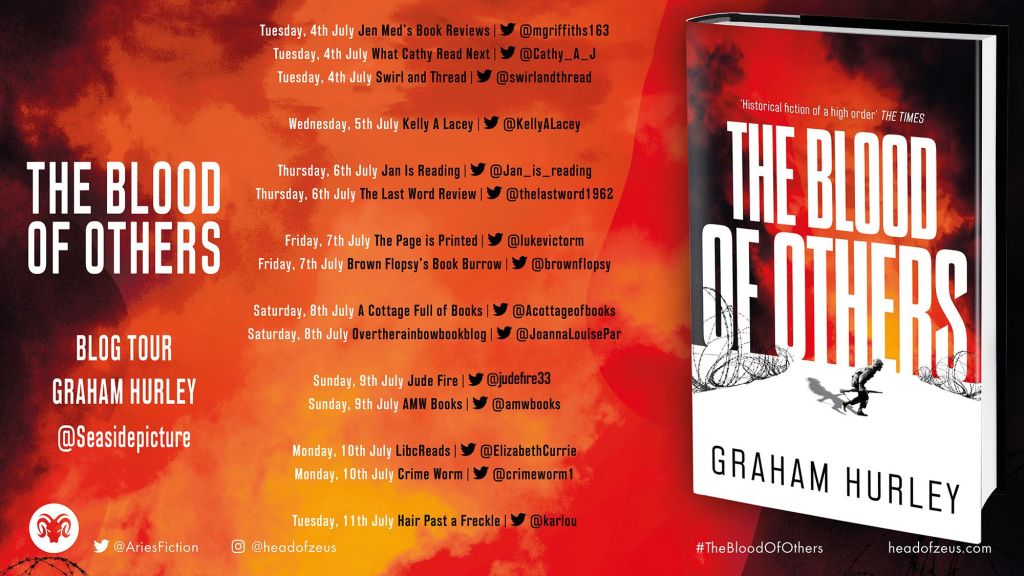
The Blood of Others by Graham Hurley

Buy Now
The new blockbuster thriller from Graham Hurley, The Blood of Others is part of the SPOILS OF WAR Collection, a thrilling, beguiling blend of fact and fiction born of some of the most tragic, suspenseful, and action-packed events of World War II.
Dieppe, August 1942. A catastrophe no headline dared admit.
Plans are underway for the boldest raid yet on Nazi-occupied France. Over six thousand men will storm ashore to take the port of Dieppe. Lives will change in an instant – both on the beaches and in distant capitals.
Annie Wrenne, working at Lord Mountbatten’s cloak-and-dagger Combined Operations headquarters, is privy to the top secret plans for the daring cross-Channel raid.
Young Canadian journalist George Hogan, protege of influential Lord Beaverbrook, faces a crucial assignment that will test him to breaking point.
And Abwehr intelligence officer Wilhelm Schultz is baiting a trap to lure thousands of Allied troops to their deaths…
Three lives linked by Operation Jubilee: the Dieppe Raid, 19 August 1942. Over six thousand men will storm the heavily defended French beaches.
Less than half of them will make it back alive.
The blockbuster SPOILS OF WAR non-chronological collection features compelling recurring characters whose fragmented lives mirror the war that shattered the globe. For fans of Philip Kerr and Robert Harris.
Thank to Sophie Ransom for the opportunity to be a part of the blog tour.
KELLY’S INSTAGRAM
Click below to learn more about my book publicity services!

In the name of full transparency, please be aware that this blog
contains affiliate links and any purchases made through such links will result in a small commission for us (at no extra cost for you).

 Love Books Tours
Interested in fact based espionage, ungentlemanly officers and spies? Do read Bill Fairclough’s fact based spy thriller, Beyond Enkription, the first stand-alone novel of six in The Burlington Files series. One day he may overtake Bond, Smiley and even Jackson Lamb but for real!
Beyond Enkription is a must read for espionage illuminati. It’s a raw noir matter of fact pacy novel. Len Deighton and Mick Herron could be forgiven for thinking they co-wrote it. Coincidentally, a few critics have nicknamed its protagonist “a posh Harry Palmer.”
It is a true story about a maverick accountant, Bill Fairclough (MI6 codename JJ) aka Edward Burlington in Porter Williams International (in real life Coopers & Lybrand now PwC). In the 1970s in London he infiltrated organised crime gangs, unwittingly working for MI6. After some frenetic attempts on his life he was relocated to the Bahamas where, “eyes wide open” he was recruited by the CIA and headed for shark infested waters off Haiti.
If you’re an espionage cognoscente you’ll love this monumental book. In real life Bill Fairclough was recruited by MI6’s unorthodox Colonel Alan Brooke Pemberton CVO MBE and thereafter they worked together on and off into the 1990s. You can find out more about Pemberton’s People (who included silent killers and Winston Churchill’s bodyguard) in an article dated 31 October 2022 on The Burlington Files website.
This epic is so real it made us wonder why bother reading espionage fiction when facts are so much more exhilarating. Whether you’re a le Carré connoisseur, a Deighton disciple, a Fleming fanatic, a Herron hireling or a Macintyre marauder, odds on once you are immersed in it you’ll read this titanic production twice. For more detailed reviews visit the Reviews page on TheBurlingtonFiles website or see other independent reviews on your local Amazon website and check out Bill Fairclough’s background on the web.
LikeLike